
The air fryer has become one of the most talked-about kitchen appliances of the past five years — a countertop gadget that promises the crunch and satisfaction of fried food with a fraction of the oil. From crispy chicken wings to perfectly roasted vegetables and even baked goods, the air fryer has found a devoted following among health-conscious home cooks, working professionals, and families seeking faster, cleaner cooking methods. India’s strong love for fried snacks — samosas, pakoras, French fries, and namkeen — has made the air fryer particularly appealing to households looking to enjoy these favourites without the deep-frying guilt.
But like every appliance that arrives with significant hype, the air fryer has real limitations alongside its genuine strengths. Understanding both sides honestly helps you decide whether it earns a permanent place on your kitchen counter or ends up in the back of a cabinet after the novelty fades. This complete guide covers every advantage and disadvantage of the air fryer with the detail and honesty that a significant purchase decision deserves.
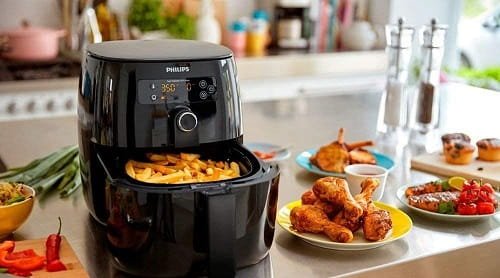
How an Air Fryer Works
An air fryer is essentially a compact convection oven — it heats air with an electric element and circulates it at high speed around food using a powerful fan. This rapid hot air circulation creates the Maillard reaction on food surfaces — the same browning and crisping chemistry that frying and roasting produce — without the food being submerged in oil. A light coating of oil (typically 1–2 teaspoons) is often applied to food before air frying to enhance browning and prevent dryness, but this is dramatically less than the 500ml–1 litre of oil used in deep frying.
Advantages of Air Fryers
1. Dramatically Less Oil
The most celebrated advantage of air frying is the reduction in cooking oil — and the health benefits this delivers. Air frying uses 70–80% less oil than traditional deep frying to achieve comparable results in terms of crispiness and texture. For households that regularly eat deep-fried foods, substituting air frying significantly reduces saturated fat intake, caloric load, and the oxidative damage associated with repeatedly heated deep-frying oil. For weight management and cardiovascular health, this reduction is genuinely meaningful.
2. Faster Cooking Than Conventional Ovens
Air fryers heat up almost instantly — there is no preheating period comparable to a conventional oven’s 10–15 minute warm-up. Once set, air fryers typically cook food 20–30% faster than conventional ovens due to the compact cooking chamber and high-velocity hot air circulation. A batch of frozen fries takes 12–15 minutes, chicken pieces cook in 20–25 minutes, and vegetables roast beautifully in 10–15 minutes. For busy weeknight cooking, this speed is a genuine practical advantage.
3. Versatility Beyond Frying
Despite the name, air fryers do far more than fry. They roast, grill, bake, dehydrate, and reheat food with excellent results. Roasted vegetables emerge with caramelised edges and tender centres. Baked goods — muffins, cookies, bread rolls — cook efficiently in the compact chamber. Reheating previously fried foods (the air fryer is particularly exceptional at restoring the crispiness of leftover pizza, spring rolls, and pakoras that go soggy in a microwave) makes it more versatile than any single-function appliance.
4. Safer Than Deep Frying
Deep frying involves large quantities of extremely hot oil — a genuine safety hazard, particularly in compact Indian kitchens. Oil splatter, accidental burns, and the catastrophic risk of oil catching fire are real dangers associated with traditional deep frying. Air fryers eliminate all of these risks — the food is enclosed in a cooking basket, no open oil is involved, and the exterior of the appliance remains cool during operation. This safety advantage is particularly significant for households with children or elderly members.
5. Easy Cleaning
Air fryer baskets and trays are typically non-stick coated and dishwasher safe. Cleaning after cooking involves rinsing the basket with soapy water — a 2-minute task compared to the extended cleaning required to dispose of, strain, and clean deep-frying oil and the associated pots. The countertop and surrounding area remain significantly cleaner than after deep frying, which typically coats nearby surfaces in oil mist.
6. Reduces Kitchen Odour and Smoke
Deep frying generates strong cooking odours and smoke that permeate the entire home. Air frying produces significantly less odour and virtually no smoke under normal operating conditions — a meaningful advantage in compact urban apartments with limited kitchen ventilation.
Disadvantages of Air Fryers
1. Cannot Truly Replicate Deep-Fried Texture
This is the most important limitation to set honest expectations around. Air-fried food is genuinely crispy and well-cooked — but it is not identical to deep-fried food. Deep frying creates a specific texture through complete oil submersion — a uniformly crispy exterior with an extremely moist, steam-cooked interior created by rapid water evaporation during immersion. Air frying creates excellent surface crispiness but the interior texture and the specific depth of crunch achieved through deep frying are not perfectly replicated. For traditional Indian fried foods like puri, bhatura, and genuine jalebi — which require specific oil interaction for their characteristic texture — the air fryer is not a viable substitute.
2. Small Cooking Capacity
Most standard air fryer baskets accommodate 3–5 litres — sufficient for 2–3 people but inadequate for large family cooking or batch preparation for guests. If you need to fry 20 samosas simultaneously for a family gathering, the air fryer forces 3–4 batches that take considerably longer than a single deep-frying batch. For households of 4–6 people cooking Indian meals where large quantities of fried snacks are prepared at once, the capacity limitation is a genuine practical frustration.
3. Requires Preheating for Optimal Results
While faster than conventional ovens, air fryers still benefit from 3–5 minutes of preheating for optimal results — cooking without preheating often produces uneven browning. For those accustomed to the immediacy of stovetop cooking, this additional step adds time.
4. Countertop Space Requirement
Air fryers are not small appliances — standard models measure 30–40 cm in height and width. In India’s often compact kitchen layouts, finding consistent countertop space is a practical challenge. Unlike thin appliances that can be stored in a cabinet and retrieved easily, the air fryer’s bulk means it either permanently occupies valuable counter space or requires effort to retrieve and put away.
5. Uneven Cooking Without Monitoring
Foods cooked in an air fryer benefit from being shaken or turned midway through cooking — the hot air circulation is excellent but not perfectly uniform around a fixed position. Without periodic turning or basket shaking, the bottom of food items may cook faster than the top, producing uneven results. This requires attention that makes the air fryer less truly hands-off than it appears.
6. Noise During Operation
The air fryer’s powerful fan — the mechanism behind its efficient hot air circulation — produces a noticeable constant whirring sound during operation. While not as loud as a mixer grinder, it is louder than a microwave oven and louder than the silence of oven cooking. In open-plan living spaces, this noise during cooking sessions may be an irritant.
7. Cost Relative to Basic Cooking Methods
Quality air fryers cost ₹3,000–₹15,000 depending on capacity and features. While this investment pays back through reduced oil consumption over time, the upfront cost is significantly higher than a traditional pressure cooker or basic pans. Budget-end air fryers often have quality control issues — uneven heating, poor non-stick coating durability, and short lifespans make the cheapest models poor value.
Should You Buy an Air Fryer?
An air fryer is an excellent investment for households that regularly eat fried snacks and want a healthier, cleaner cooking method — particularly for reheating, roasting vegetables, and cooking frozen foods. It is also excellent for singles and couples who want fast, convenient cooking with minimal cleanup. For large families cooking high-volume Indian fried foods, it works best as a secondary appliance alongside a gas stove rather than as a standalone solution.