
India’s electric vehicle revolution has arrived — and in 2026, it is no longer a fringe movement driven by early adopters. It is a mainstream market reality. GST at a concessional 5% on electric vehicles, the FAME II programme, state-level road tax waivers, and rapidly expanding public charging networks have collectively made EV ownership more practical and financially compelling than ever. The Indian EV market now offers 62 electric car models spanning from the MG Comet EV at ₹7.50 lakh to luxury electric vehicles approaching ₹10 crore. Real-world ranges of 250 to 600 kilometres on a single charge mean most buyers can manage their daily commutes and even weekend getaways without range anxiety. Running costs as low as ₹1.50 per km on home charging make the long-term economics of EV ownership increasingly difficult to argue against. Here are India’s ten best EV cars in 2026.
Quick Comparison — Top 10 Best EV Cars in India 2026
| Car | Starting Price (Ex-Showroom) | Battery | Claimed Range | Key Highlight |
| MG Comet EV | ₹7.50 Lakh | 17.3 kWh | 230 km | Cheapest EV in India |
| Tata Tiago EV | ₹7.99 Lakh | 19.2 / 24 kWh | 250 / 315 km | Best budget EV hatchback |
| Tata Punch EV | ₹9.69 Lakh | 25 / 35 kWh | 315 / 421 km | Most popular EV in India |
| MG Windsor EV | ₹14.00 Lakh | 38 kWh | 331 km | Highest-selling EV in India |
| Maruti Suzuki e Vitara | ₹15.99 Lakh | 49 / 61 kWh | 500+ km | Best new mainstream EV |
| Tata Nexon EV | ₹17.29 Lakh | 30 / 45 kWh | 325 / 465 km | 5-Star safety EV SUV |
| Hyundai Creta Electric | ₹17.99 Lakh | 42 / 51.4 kWh | 390 / 473 km | Premium mainstream EV SUV |
| Mahindra BE 6 | ₹18.90 Lakh | 59 / 79 kWh | 535 / 682 km | Best performance EV |
| Mahindra XEV 9e | ₹21.90 Lakh | 59 / 79 kWh | 542 / 656 km | Flagship RWD electric SUV |
| Kia EV6 | ₹60.97 Lakh | 77.4 kWh | 528 km | Best premium EV experience |
Top 10 Best EV Cars in India 2026 — Detailed Review
1. MG Comet EV — From ₹7.50 Lakh
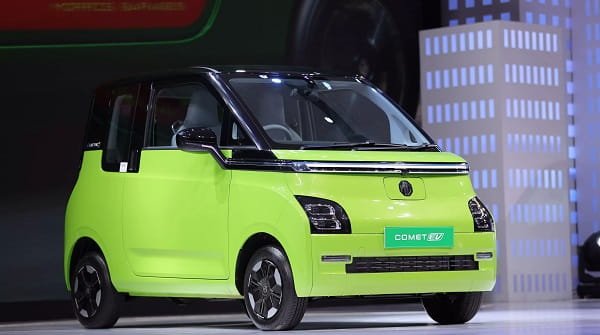
India’s most affordable electric car makes EV ownership genuinely accessible — a city-focused ultracompact with dual 10.25-inch screens and connected car technology at an entry-level price.
The MG Comet EV is a genuine milestone — bringing electric mobility to a price bracket that no Indian manufacturer had previously targeted. Built for urban commuting with a 17.3 kWh battery and 230 km claimed range, it is perfectly suited for the average Indian urban daily commute of 30-50 km. Its dual 10.25-inch screens, connected car features, and ultracompact footprint for easy city parking make it a genuinely intelligent urban transport solution. For solo commuters, young professionals in dense cities, or households seeking an affordable second car that eliminates fuel costs entirely for daily use, the Comet EV is unrivalled at its price.
2. Tata Tiago EV — From ₹7.99 Lakh
The Tata Tiago EV democratises electric hatchback ownership in India — offering the choice of two battery sizes and the Tiago’s proven platform at India’s most accessible EV hatchback price.
The Tata Tiago EV made Indian EV history as the country’s first mass-market electric hatchback — bringing the accessibility of the Tiago platform to electric mobility. Available in 19.2 kWh (250 km) and 24 kWh (315 km) battery options, it gives buyers real-world flexibility based on usage patterns. The cabin retains the Tiago’s well-designed features, and Tata’s charging network support across India gives owners practical infrastructure reassurance. For urban families and first-time EV buyers who are not ready to spend on mid-range options, the Tiago EV remains India’s most credible entry-level electric hatchback.
3. Tata Punch EV — From ₹9.69 Lakh
India’s most popular EV is also its safest — the Punch EV combines five-star safety, SUV character, impressive range, and the 6-in-1 electric powertrain that makes it uniquely versatile.
The Tata Punch EV is India’s most popular electric car — chosen by CarWale as the top electric car pick for 2026, combining genuine micro-SUV character with EV practicality at a price that has proven accessible to a mass market. Its innovative 6-in-1 electric powertrain with multiple driving modes, available in 25 kWh (315 km) and 35 kWh (421 km) packs, combined with Tata’s established 5-star safety credentials and a fast-growing Tata.ev charging infrastructure, create India’s most complete sub-₹15 lakh EV proposition. The raised seating position, confident road manner, and Tata’s improving quality standards make it genuinely satisfying to own daily.
4. MG Windsor EV — From ₹14.00 Lakh
India’s highest-selling EV in 2026 combines a generous 38 kWh battery, 331 km range, and MG’s well-regarded connected car ecosystem into the country’s most popular mainstream electric choice.
The MG Windsor EV is India’s highest-selling electric car — and its success is built on a combination of genuine value, strong features, and MG’s trust as a connected technology brand. A 38 kWh battery delivering 331 km claimed range, wireless Android Auto and Apple CarPlay, large panoramic sunroof, ventilated seats, and a well-fitted premium interior create a compelling mid-range EV package. MG’s battery-as-a-service (BaaS) model option — allowing buyers to reduce upfront cost by leasing the battery — further lowers the ownership entry barrier that has historically deterred mainstream buyers from EVs.
5. Maruti Suzuki e Vitara — From ₹15.99 Lakh
The e Vitara is Maruti’s landmark entry into India’s EV market — bringing the country’s most trusted car brand’s service network and ownership convenience to mainstream electric mobility.
The Maruti Suzuki e Vitara represents the most significant EV launch in Indian automotive history — bringing Maruti’s unmatched pan-India service network, brand trust, and financing ecosystem to the electric car market for the first time. Available with 49 kWh and 61 kWh battery options offering 500-plus km claimed range in the larger pack, the e Vitara brings genuine long-range confidence to mainstream EV buyers. For the millions of Indians who have historically bought Maruti vehicles specifically because they trust the brand’s ownership experience, the e Vitara finally bridges the gap between that trust and electric mobility.
6. Tata Nexon EV — From ₹17.29 Lakh
The Tata Nexon EV brings India’s most safety-trusted compact SUV platform to electric mobility — combining a five-star NCAP rating with ADAS, strong real-world range, and established charging infrastructure.
The Tata Nexon EV with its updated 30 kWh (325 km) and 45 kWh (465 km) battery options, now including ADAS technology and a comprehensive feature update, remains one of India’s most complete and trusted electric SUVs. The 5-star Global NCAP safety architecture in an EV configuration gives it a safety credibility that no competitor at its price matches. JBL audio, panoramic sunroof, voice control, and Tata’s established Tata.ev charging network and home charging support create an ownership experience that has been refined over several years of real-world Indian EV feedback.
7. Hyundai Creta Electric — From ₹17.99 Lakh
The Hyundai Creta Electric brings India’s best-selling mid-size SUV’s brand trust and interior quality to the EV space — with two battery options and Hyundai’s premium connected features.
The Hyundai Creta Electric leverages the Creta’s dominant brand position — India’s most popular mid-size SUV nameplate — to attract mainstream buyers into the EV space. Available with 42 kWh (390 km) and 51.4 kWh (473 km) packs, it delivers genuine long-distance confidence. The full Creta feature set — dual 10.25-inch screens, ADAS, panoramic sunroof, ventilated seats — translated into an EV platform creates a premium electric SUV experience that Hyundai buyers find naturally familiar. V2L (Vehicle-to-Load) functionality and V2G charging compatibility add future-proof utility.
8. Mahindra BE 6 — From ₹18.90 Lakh
The Mahindra BE 6 is India’s most exciting performance EV at a mainstream price — delivering 0-100 km/h in 6.7 seconds from a 79 kWh battery with exclusively rear-wheel drive.
The Mahindra BE 6 brings genuine performance EV character to a price bracket that India has never seen it occupy before. The RWD layout with 79 kWh battery delivering a claimed 682 km range and 0-100 km/h in 6.7 seconds creates a driving experience that premium European EVs costing three times as much struggle to exceed in pure engagement. Seven airbags, ADAS, a futuristic interior, and Mahindra’s improving build quality back the performance with safety and technology credentials. The BE 6 represents Mahindra’s most ambitious and successful product statement in the EV era.
9. Mahindra XEV 9e — From ₹21.90 Lakh
The XEV 9e is Mahindra’s flagship electric SUV — combining a 656 km claimed range, 0-100 km/h in 6.8 seconds, and segment-first technology that signals India’s EV ambitions on a global stage.
The Mahindra XEV 9e is India’s most technologically ambitious mainstream EV — combining 79 kWh battery with 656 km claimed range and a 0-100 km/h time of 6.8 seconds from its rear-wheel drive setup. The three-screen interior layout, ADAS suite, adaptive cruise control, and wireless connectivity create a premium technology experience that would be credible in a car priced ₹30-40 lakh higher. For buyers who want the maximum technology, range, and performance statement per rupee in India’s EV market, the XEV 9e is currently without parallel.
10. Kia EV6 — From ₹60.97 Lakh
The Kia EV6 is India’s best premium electric driving experience — combining an 800V ultra-fast charging architecture, 528 km range, and a genuinely world-class EV platform.
The Kia EV6 stands as India’s benchmark premium EV — built on Hyundai’s E-GMP platform with 800V ultra-fast charging capability that charges from 10-80% in under 18 minutes, a 77.4 kWh battery delivering 528 km range, and a GT-Line and GT variant range delivering up to 585 bhp in all-wheel drive. The interior is genuinely world-class — wide panoramic display, premium materials, and vehicle-to-load capability. For buyers who want a premium electric experience that can compete with the best European EVs while offering Kia’s reliability and aftersales support in India, the EV6 is the definitive choice.
FAQs — Best EV Cars in India 2026
Q1. What is the cheapest electric car in India in 2026?
A: The MG Comet EV starts from ₹7.50 lakh and the Tata Tiago EV from ₹7.99 lakh — both making EV ownership accessible at near-entry-level pricing.
Q2. What is the real-world running cost of an EV in India?
A: Home charging typically costs ₹1.50 to ₹2 per km, while public charging runs ₹2.50 to ₹4 per km — both dramatically lower than petrol at ₹6-8 per km.
Q3. What is the typical battery warranty on EVs in India?
A: Most manufacturers offer 8-year / 1.6 lakh km battery warranties — covering capacity loss below a specified threshold, typically 70-80% of original capacity.
Q4. Which EV has the best range in India in 2026 among mainstream models?
A: The Mahindra XEV 9e claims 656 km (79 kWh pack) and the Mahindra BE 6 claims 682 km — the longest ranges among mainstream Indian-market EVs.
Q5. Is EV charging infrastructure adequate in India in 2026?
A: Major cities and national highways now have reasonable charging coverage. Tata, MG, Hyundai, and Mahindra all operate dedicated charging networks, and government-mandated charging at fuel stations is accelerating infrastructure rollout significantly.