
Induction cooktops have quietly become one of the most talked-about kitchen appliances in Indian homes over the past decade. Once considered a premium product for urban apartments, they are now available across all price ranges and are increasingly replacing traditional gas stoves in modern kitchens. Their compact design, energy efficiency, and safety features make them genuinely attractive — but like every appliance, they come with real limitations that every buyer should understand before purchasing.
Whether you’re setting up a new kitchen, looking to reduce your gas bill, or simply curious about whether induction cooking suits your household, this guide covers everything honestly. Here is a complete breakdown of the advantages and disadvantages of induction cooktops to help you make the right decision.
How an Induction Cooktop Works
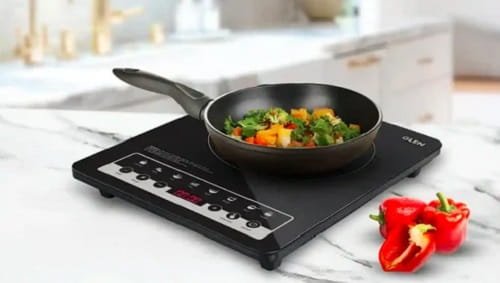
Before evaluating the pros and cons, a quick understanding of the technology helps. Unlike a gas flame or electric coil that generates heat externally and transfers it to the vessel, an induction cooktop works through electromagnetic induction. The cooktop surface contains a copper coil. When you switch it on, an alternating current passes through the coil and creates a magnetic field. This magnetic field induces an electric current directly in the base of the cookware — and that current generates heat inside the vessel itself.
This means the cooktop surface does not get hot from the cooking process — the vessel heats up directly, making induction fundamentally different from every other cooking method. However, this technology requires induction-compatible cookware with a magnetic base — typically iron, cast iron, or magnetic stainless steel — which is one of its most important limitations.
Advantages of Induction Cooktops
1. Exceptional Energy Efficiency
Induction cooktops are significantly more energy-efficient than both gas stoves and traditional electric coil burners. Because heat is generated directly inside the vessel rather than from an external flame or element, almost no energy is wasted heating the surrounding air. Induction cooktops are approximately 85–90% energy efficient, compared to around 40–55% for gas stoves. This translates to meaningfully lower electricity bills over time — particularly for households that cook multiple meals daily.
2. Faster Cooking Times
Because heat transfers directly to the vessel, induction cooktops bring water to boil, heat oil, and cook food considerably faster than gas at equivalent power settings. A litre of water that takes 8–10 minutes on a gas burner can boil in 4–5 minutes on a 2000-watt induction cooktop. For busy households and working individuals, this time saving accumulates significantly across daily cooking routines.
3. Precise Temperature Control
Induction cooktops offer the most precise temperature control of any cooking method. Because the power level directly and immediately controls the heat inside the vessel, you can adjust from a rolling boil to a gentle simmer in seconds — with far greater accuracy than gas, where flame adjustment is approximate. This precision is particularly valuable for tasks like melting chocolate, making custards, tempering spices, and simmering delicate sauces where temperature consistency matters.
4. Superior Safety
This is one of the most compelling advantages, particularly for households with children and elderly members. Since the cooktop surface itself does not generate heat — only the magnetic vessel does — the glass surface around a cooking vessel remains relatively cool. There is no open flame, which means no risk of gas leaks, accidental fires from clothing catching flame, or burns from touching the cooktop surface away from the vessel. The automatic shut-off when cookware is removed and child lock features on most models add additional safety layers.
5. Easy to Clean
The flat, smooth glass-ceramic surface of an induction cooktop is dramatically easier to clean than a gas stove with its grates, burner caps, and crevices that trap food and grease. Since the surface around the vessel stays cool, food spills do not burn onto it — they simply wipe away with a damp cloth. A quick wipe after cooking keeps the surface looking brand new for years. For people who dislike the cleaning effort of maintaining a gas stove, this advantage alone is often decisive.
6. Portable and Compact
Unlike built-in gas hobs or fixed kitchen setups, portable induction cooktops can be moved anywhere in the home — ideal for small apartments, hostel rooms, paying guest accommodations, and kitchen extensions. They plug into a standard 5-amp or 15-amp socket depending on the wattage, require no installation, and can be stored in a drawer when not in use. This portability makes them exceptionally practical for renters, students, and urban dwellers with limited kitchen space.
7. No Indoor Air Pollution
Gas combustion produces carbon monoxide, nitrogen dioxide, and particulate matter inside the kitchen — contributing to indoor air pollution that affects respiratory health over long-term exposure. Induction cooking generates no combustion byproducts, making the kitchen environment significantly cleaner. This is an underappreciated health benefit, particularly in compact Indian kitchens with limited ventilation.
Disadvantages of Induction Cooktops
1. Requires Special Induction-Compatible Cookware
This is the biggest practical limitation for most Indian households. Induction cooktops only work with cookware that has a magnetic base — iron, cast iron, and magnetic stainless steel. Traditional aluminium vessels, copper pots, and regular steel cookware do not work on induction. Most Indian kitchens have decades of accumulated aluminium and regular steel cookware that becomes instantly incompatible. Replacing or adding an entire set of induction-compatible vessels is an additional cost that buyers often underestimate. You can test compatibility simply — if a magnet sticks firmly to the base of your vessel, it works on induction.
2. Power Cuts Render It Useless
Induction cooktops are entirely dependent on electricity. During power cuts — which remain common across many Indian cities and towns — your induction cooktop is completely non-functional. Households relying solely on induction for cooking need a backup cooking solution. This dependence on stable electricity supply is a genuine lifestyle consideration in regions with unreliable power infrastructure.
3. Can Be Noisy
Many induction cooktops produce a low humming or buzzing sound during operation — caused by the cooling fan that prevents the internal electronics from overheating. While it is not loud enough to be disruptive in most cases, people sensitive to ambient noise find it noticeable, particularly during long cooking sessions like slow-simmering dal or rice.
4. Not Ideal for All Indian Cooking Techniques
Traditional Indian cooking involves techniques like direct flame charring (making rotis on the tawa with direct flame contact on both sides, charring brinjal or capsicum), tadka with naked flame, and rapid high-heat stir-frying in a round-bottomed wok (kadai). Induction cooktops require flat-based cookware and cannot replicate the instant, intense high heat of a gas flame for certain cooking techniques. Tandoor cooking, direct roti charring, and charcoal-smoked flavours are simply not possible on induction.
5. Glass Surface Can Scratch or Crack
The glass-ceramic surface, while beautiful, is vulnerable to scratches from rough-based cookware and can crack under impact — dropping a heavy vessel on the surface can cause permanent damage. Cast iron cookware, while induction-compatible, needs to be placed and lifted carefully rather than dragged across the surface. Replacement of a cracked cooktop surface is expensive and sometimes not economically viable on lower-priced models.
6. Higher Initial Cost Compared to Basic Gas Stoves
While entry-level induction cooktops are now available for as little as ₹1,500–₹2,000, a quality model with good wattage, reliable controls, and durability costs ₹3,000–₹8,000. Add the cost of new induction-compatible cookware and the initial investment becomes considerable compared to a basic two-burner gas stove. The long-term energy savings offset this over time — but the upfront cost can be a barrier.
Should You Buy an Induction Cooktop?
An induction cooktop is an excellent primary or secondary cooking appliance if your household has reliable electricity, is willing to invest in compatible cookware, and primarily cooks meals that don’t depend heavily on open-flame techniques. It is particularly ideal for small families, urban apartments, students, office kitchens, and people prioritising safety, cleanliness, and energy efficiency.
However, if you live in an area with frequent power cuts, cook traditional Indian meals that rely on direct flame techniques, or cannot budget for new cookware, keeping your gas stove as the primary cooking method while using induction as a supplementary appliance is the most practical approach. Many modern Indian kitchens use both — and that combination truly offers the best of both worlds.