
The electric tandoor is one of India’s most culturally significant kitchen appliance innovations — bringing the beloved flavours of tandoor cooking into urban homes without the space, safety requirements, and complexity of a traditional clay tandoor. For a country where tandoor-cooked items — naan, tandoori roti, tandoori chicken, tikka, and baked kebabs — are not just restaurant treats but deeply desired everyday foods, the electric tandoor addresses a genuine gap in the home cooking toolkit.
Traditional clay tandoors require outdoor space, significant setup, charcoal or wood fuel, and expertise to manage — making them impractical for apartment living. Electric tandoors, available from ₹2,000 to ₹8,000, promise tandoor-quality cooking in a compact electric appliance that fits on a countertop. How well they deliver on this promise — and where they fall short — is what this guide examines honestly.
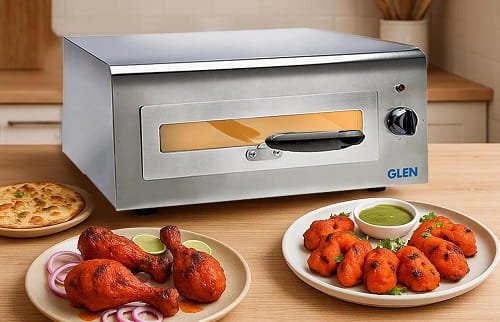
How an Electric Tandoor Works
An electric tandoor consists of a cylindrical or dome-shaped metal body with an electric heating element that heats the inner chamber to high temperatures (typically 250–350°C). Food is placed on a wire rack or suspended from hooks inside the chamber. The enclosed high-heat environment approximates the cooking conditions of a clay tandoor — high radiant heat from multiple directions cooking food quickly while creating surface charring and characteristic flavours. Most models have a rotating spit mechanism for even cooking of larger items.
Advantages of Electric Tandoors
1. Authentic Tandoor Flavours at Home
The electric tandoor genuinely delivers significantly closer to authentic tandoor flavour than a conventional oven, a microwave, or stovetop cooking. The high-temperature enclosed cooking environment creates the charring, smokiness, and crust formation that defines tandoor-cooked food. Tandoori roti, naan, and kulcha cooked in a good electric tandoor have the characteristic puffing, charred spots, and smoky undertone that oven-baked versions lack.
2. Healthier Cooking Method
Tandoor cooking uses no oil — food cooks through radiant high heat without any frying medium. Fat from meat drips away during cooking rather than being reabsorbed. This produces chicken, paneer, and vegetable preparations that are genuinely lower in fat than pan-fried or deep-fried versions, without sacrificing the satisfying charred flavour that makes tandoor cooking feel indulgent.
3. Versatility
Electric tandoors handle an impressive range of preparations: tandoori roti, naan, kulcha, pizza, garlic bread, tandoori chicken, paneer tikka, fish tikka, seekh kebabs, vegetable skewers, baked appetisers, and even small baking tasks like cookies and muffins. For households that enjoy varied cooking including both Indian and Continental preparations, the electric tandoor’s versatility makes it genuinely multi-purpose.
4. No Charcoal or Wood Required
Traditional tandoor cooking requires sourcing, storing, and managing charcoal or wood fuel — impractical for apartment living. Electric tandoors require only a standard power outlet, eliminating fuel management entirely. They can be used indoors with reasonable ventilation and do not produce the ash, smoke, or fire management challenges of traditional tandoors.
5. Reaches Cooking Temperature Quickly
Electric tandoors heat to cooking temperature in 10–15 minutes — faster than a conventional oven and far faster than getting a charcoal tandoor to cooking temperature. This quick heat-up time makes them practical for everyday cooking rather than only for special occasions.
Disadvantages of Electric Tandoors
1. Cannot Fully Replicate Traditional Tandoor Flavour
The most important honest assessment: while electric tandoors produce significantly better results than ovens for Indian breads and tandoori preparations, they do not perfectly replicate a traditional clay tandoor. The specific flavour created by the moisture-absorbing clay walls of a traditional tandoor, the smoking from dripping fat hitting hot clay, and the specific temperature gradient inside a large clay vessel are not fully reproducible in a metal electric appliance. Enthusiasts and professional chefs will notice the difference.
2. Large and Heavy
Electric tandoors are among the largest countertop appliances available — most models are 40–50 cm in diameter and height and weigh 5–10 kg. Finding permanent counter space or easy storage for an appliance of this size in a compact Indian kitchen is a genuine practical challenge. Unlike a sandwich maker that stores in a drawer, the electric tandoor requires dedicated space.
3. High Power Consumption
Electric tandoors typically consume 1,500–2,500 watts — among the highest of any kitchen countertop appliance. Regular daily use will produce noticeable increases in electricity consumption. The running cost is lower than restaurant ordering but higher than gas cooking for equivalent food preparation.
4. Uneven Cooking in Some Models
Lower-priced electric tandoor models can have uneven heat distribution — one side cooking faster than another, or the top section being cooler than the bottom. Rotating food manually during cooking is required for even results in these models, reducing the hands-free convenience.
5. Cleaning Challenges
The interior of an electric tandoor — with its high-heat charring of fats, marinades, and spice pastes — can be difficult to clean thoroughly. Carbonised residue builds up on interior surfaces and the wire racks over time, requiring soaking and scrubbing that is more effort than cleaning a non-stick surface.
Verdict
The electric tandoor is excellent for households that love tandoori cooking and want to replicate restaurant-quality results at home for roti, naan, tikka, and kebabs. It works best in larger kitchens where it can have a permanent placement. For occasional tandoori cooking, the investment and space requirement may outweigh the benefits — a good oven on its highest setting serves the occasional need acceptably.